Three Uncomfortable Truths About How Solopreneurs See Themselves
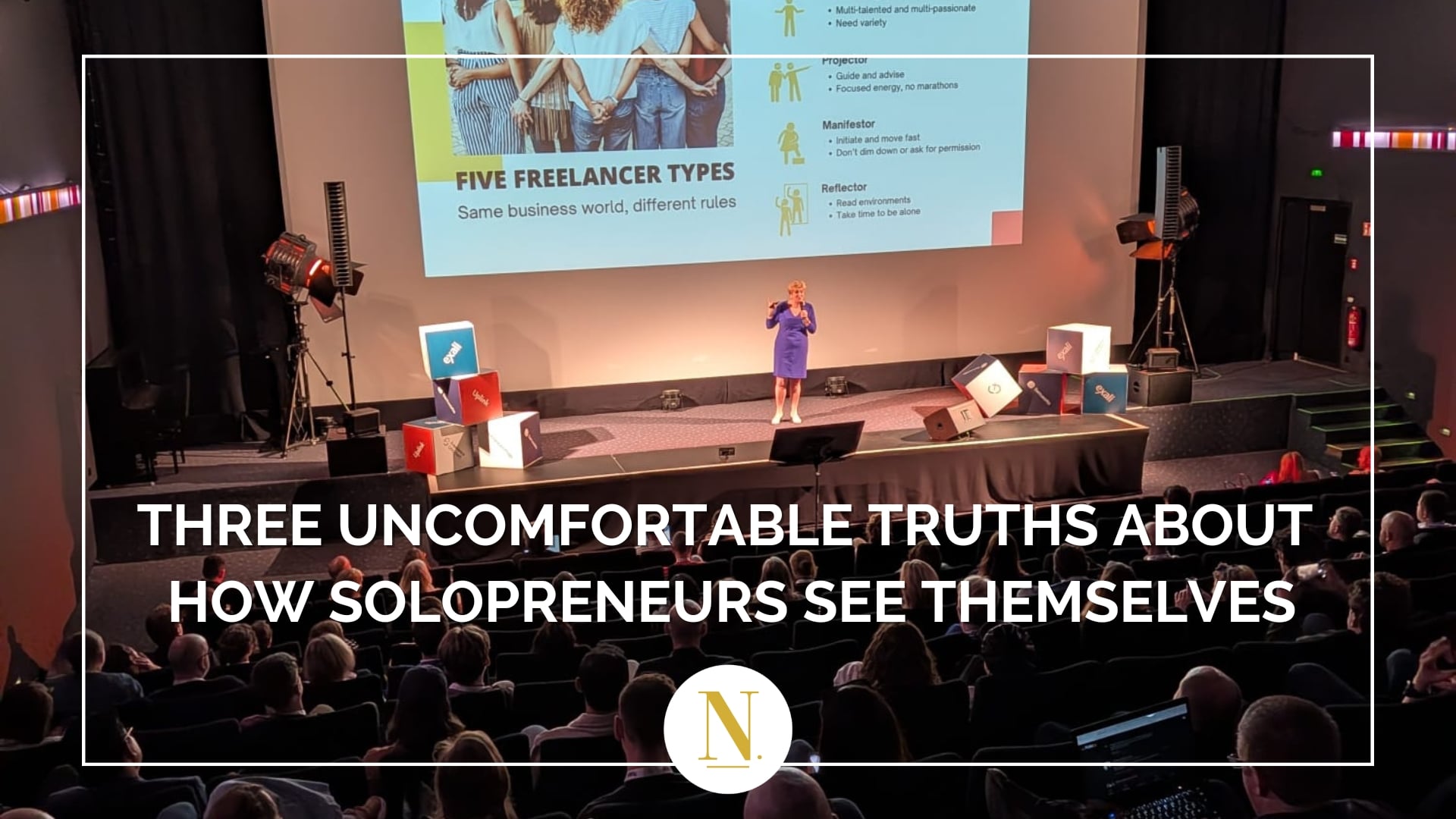
Last week I was in Berlin for Freelance Unlocked, and it was one of those events that gives you more than you went looking for.
Wonderful conversations with talented, driven professionals from all over the world, and somewhere between the coffee and the hallway chats, a few patterns emerged that I haven't been able to stop thinking about.
I spoke on stage, and after that with many freelancers, solopreneurs, and independent professionals from all kinds of backgrounds. Coaches and consultants, yes, but also UX designers, programmers, IT specialists, systems architects, and the kind of quietly brilliant people who make sure complex things run without breaking.
Some were just starting out, others had been running their own businesses for years. And no matter where they were in their journey, I kept hearing the same things. Different words, same pattern. The same quiet struggle underneath every coffee conversation and hallway chat.
Three things came up again and again, and I want to talk about them here because I think they might be familiar to you too.
The first one: professionals genuinely do not know how good they are.
This one surprised me, even though it probably shouldn’t have. I’ve been in this industry for over thirty years. I know this pattern exists. But there’s something about being in a room full of smart, capable people and realising, over and over again, that almost none of them have a clear sense of their own value, that makes it land differently.
People were describing their work in the most understated, almost apologetic way. “I help with communication.” “I do change management for organizations”, “I do strategy consulting, but it’s a bit hard to explain.” “I build back-end systems.” “I make interfaces easier to use.” And then, five minutes into the conversation, they’d casually mention something extraordinary. A change manager who got a company on the ‘Great Place To Work’ list. An IT consultant who had prevented a data breach that would have taken the organisation years to recover from. A systems architect who had untangled something so complex that three previous contractors had walked away from it.
These people were describing their work as though it was ordinary. As though anyone could have done it. As though the scale of what they’d prevented or created or fixed was somehow beside the point.
I recognise this. Because I did it too.
For a long time I described what I did as “coaching” or “business mentoring,” which is technically true and completely missing the point. I help professionals rebuild their entire relationship with how they work, who they are, what they offer and what they’re charging for it. That is not a small thing. But for years I minimised it. I used language that made me sound less threatening, less complicated, or easier to swallow. It took me a long time to realise I was not making it easier for people to hire me. I was making it easier for them to overlook me.
If you recognise yourself in this: it is not humility. It is a habit. And habits can be changed.
The second thing that kept coming up: the invisible work problem.
This one is thorny, and I spent a lot of time thinking about it on the flight home.
Many of the people I spoke with are doing work that, by its very nature, disappears when it goes well. The system that never goes down, the security patch applied before the breach ever happened, the conflict that doesn’t escalate, or the project that runs smoothly from start to finish. This is genuinely hard to sell, because the proof of your work is the absence of a problem.
I sat with a programmer who had spent years building and maintaining infrastructure that kept a series of platforms running without interruption. He was exceptional at what he did. But because nothing had ever broken, there was almost no story to tell. No drama, no rescue, no visible before and after. Just quiet, consistent excellence that everyone around him had come to take completely for granted. How do you make a case for your value when your greatest achievement is that nothing has ever gone wrong on your watch?
I suggested a reframe that seemed to click for several people I spoke with: stop trying to describe what you do, and start describing what becomes visible when your work isn’t done. What organization results look like when strategy isn’t clear for all employees? What does a platform look like when no one is maintaining it properly? What does a company experience when a data breach occurs because security patches weren’t applied? Once you start thinking from that angle, your value comes into sharp relief.
I have had my own version of this. Human Design in itself is an invisible system. Its results don’t always produce a dramatic visible outcome. The client who stops burning out, the coach who finally prices herself properly, the solopreneur who stops chasing leads that drain him, none of these announce themselves loudly. For years I struggled to position what I do because the most important thing it creates is an internal shift that reshapes everything, and internal shifts are notoriously hard to put on a website.
What helped me was writing about the before, because I know first hand what that feels like. Not just the transformation, but the before. The sleepless nights running the wrong kind of business. The exhaustion of performing strategies that didn’t fit. The slow erosion of confidence that comes from consistently overworking and under-earning. That was something people could see themselves in. And from there, they could begin to understand what I actually offer.
The third thing: they find it genuinely difficult to express their expertise.
This is connected to the first two, but it is also its own thing. Even the people who had a sense of their own value, and even some who could describe their work reasonably well, still struggled to say, clearly and confidently, “I am the expert in this.”
The moment you claim expertise, things get uncomfortable. You’re making a statement that can be challenged. You’re stepping forward when everything in you has been trained to wait to be noticed. You’re asking someone to trust you before you’ve proved it to them yet again, because apparently the last ten times didn’t fully count.
I noticed this particularly with the technical professionals at the event. The programmers, the IT specialists, the systems people. Many of them had spent years being the person in the room who actually understood how things worked, while others around them took the credit, wrote the proposals, or gave the presentations. They were used to their expertise being assumed, borrowed, or simply invisible. Speaking about it directly, claiming it as their own, positioning themselves as the authority rather than the quiet engine behind someone else’s authority, felt almost foreign.
I know this discomfort in my own way. I have been working in the coaching industry since before many of my current clients started their businesses. I have genuine, earned expertise. And still, for years, I softened it. I wrote copy that felt nuanced, but was downsizing what I really do. I gave talks that opened with disclaimers. I positioned myself as someone who “explores” things rather than someone who knows them.
The shift happened slowly, and it happened because I stopped trying to earn my authority through visible credentials and started speaking from the place where I actually live: my own experience of building an aligned business, my own understanding of how Human Design works in real life after working with hundreds of clients, my own years of listening to people describe the same patterns in different languages.
You cannot wait to feel confident before you speak with authority. The confidence comes from the speaking. That is the uncomfortable truth I keep coming back to.
So what do we do with all of this?
The professionals I spoke with in Berlin are not lacking talent. They are not lacking experience. What many of them are lacking is a clear, confident way to show the world what they actually bring. And that is not a minor thing. That is the difference between a business that quietly struggles and one that genuinely thrives.
This is exactly the work I have been doing for years with my clients, and it is also the work I have done on myself. Because it doesn’t go away. There is no point where you finally feel visible enough or credible enough or worthy enough to just be seen. You have to choose to step forward, again and again, until it becomes the natural thing you do.
If this resonates with you, I have something that might help.
I put together a free guide called From Quietly Brilliant to Well-Known Expert. It walks you through the specific shifts that take you from being someone who is underestimated, including by yourself, to someone whose expertise is clear, whose positioning is sharp, and whose visibility feels like a natural expression of who you already are.
You can download it HERE.
Fill in your date of birth, time of birth and place of birth, and you’ll get a personalized download with practical tips for your Human Design.
If any part of what I described today sounds like you, I think you’ll find it useful. Not as a formula, but as a mirror. Sometimes the most powerful thing is simply having someone put into words what you’ve been living but couldn’t quite name.